

How To Install Apps Using Usb Debugging
Using an external drive, you lot can install or reinstall the Mac operating system on a supported device. Apple recommends only system administrators follow these steps since a bootable installer isn't necessary to update or fifty-fifty reinstall macOS. A bootable installer is ideally suited for installing macOS on multiple devices.
The newest MacBooks just have USB-C ports. To install macOS on these computers, you'll need a flash bulldoze that supports USB-C or a USB hub or adapter. The file or bulldoze must back up Mac OS Extended and have at least 14GB of available storage.
Choose one of our favorite flash drives or best external drives to serve every bit your bootable installer. Currently, you can but create a bootable installer for macOS Big Sur, Catalina, Mojave, High Sierra, or El Capitan.
If you want to go back to your previous macOS, here'due south how to downgrade macOS.
1. Download macOS
On a MacBook or Mac desktop reckoner, download the version of macOS that suits your needs.
The macOS file volition download to your Applications folder. Once the download is complete, you'll see the file named 'macOS [version proper noun]'.
To get the correct installer, download from a Mac that is using macOS Sierra 10.12.five or subsequently, or El Capitan x.11.6. Enterprise administrators should download from Apple, not a locally hosted software-update server.
- macOS Big Sur
- macOS Catalina
- macOS Mojave
- macOS Loftier Sierra
For an OS X El Capitan installation, the file gets saved as a disk image named 'InstallMacOSX.dmg'. To install, open the disk prototype and run the installer named 'InstallMacOSX.pkg'.
From in that location, information technology installs an app named 'Install Os X El Capitan' into your Applications folder. You volition create the bootable installer from this app, not from the disk image or .pkg installer.
2. Use Terminal
One time you take your bootable installer prepare, it'south time to move to the next footstep. Connect the USB wink bulldoze to the estimator you wish to install macOS. Choose 'Finder' then select 'Go' from the card bar. Click 'Utilities', then 'Final'.
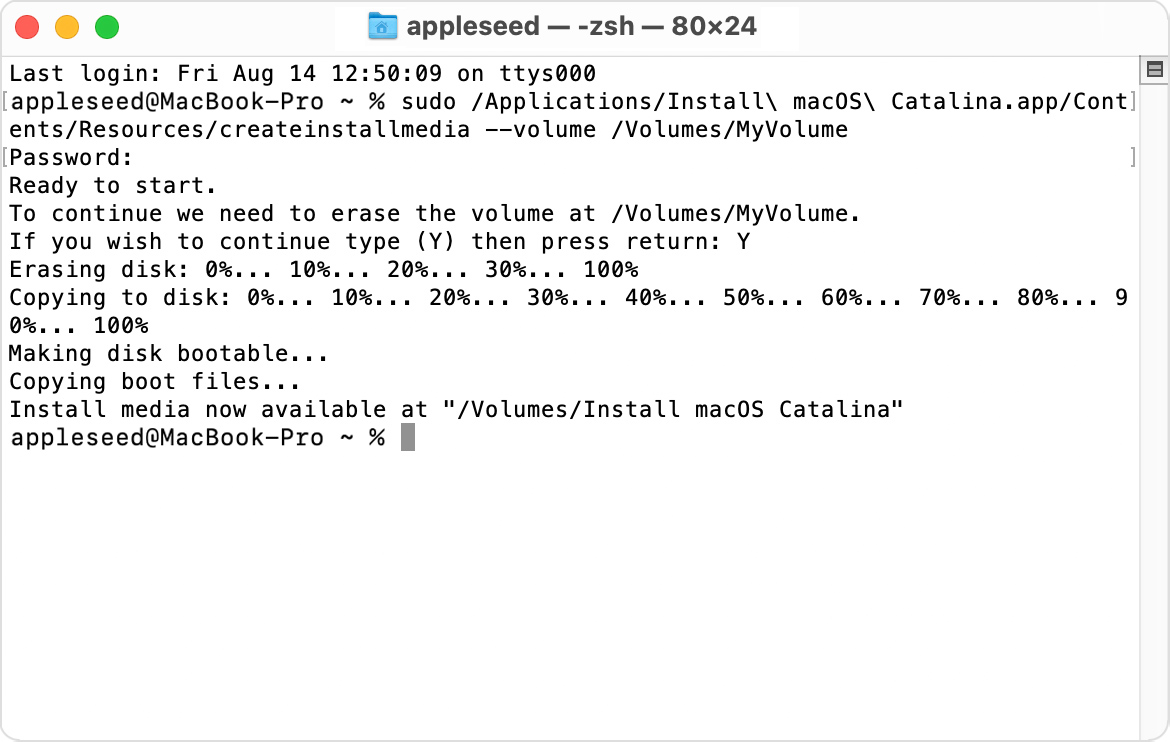
In the next step, you lot'll enter a control in Terminal. The command differs, depending on the macOS version you're going to install. With each control, information technology'southward assumed the installer is located in your 'Applications' folder and 'MyVolume' is the name of the USB flash drive. Change the proper noun in the command to friction match your settings, if necessary.
For macOS Big Sur, re-create and paste the post-obit into Terminal:
sudo /Applications/Install\ macOS\ Big\ Sur.app/Contents/Resource/createinstallmedia --volume /Volumes/MyVolume For macOS Catalina:
sudo /Applications/Install\ macOS\ Catalina.app/Contents/Resource/createinstallmedia --book /Volumes/MyVolume For macOS Mojave:
sudo /Applications/Install\ macOS\ Mojave.app/Contents/Resources/createinstallmedia --volume /Volumes/MyVolume For macOS Loftier Sierra:
sudo /Applications/Install\ macOS\ Loftier\ Sierra.app/Contents/Resources/createinstallmedia --book /Volumes/MyVolume For Bone X El Capitan:
sudo /Applications/Install\ OS\ X\ El\ Capitan.app/Contents/Resources/createinstallmedia --volume /Volumes/MyVolume --applicationpath /Applications/Install\ Bone\ 10\ El\ Capitan.app three. Continue with Terminal
After pasting the command to a higher place, hitting the 'Render' key. Type your administrator password when prompted, so press 'Return' again. Type 'Y' to confirm that you lot desire to erase the volume, then printing 'Return'. If asked, click 'OK' to allow the copying of files to proceed. Quit 'Terminal'.
You've at present successfully created a bootable installer that you can use to install macOS on other machines.
4. Employ bootable installer
Information technology's now fourth dimension to use the bootable installer to install a fresh re-create of macOS. The steps are different, depending on whether you're using an Intel-based Mac or one with Apple silicon.
For Intel-based machines:
Plug the bootable installer into a Mac that's continued to the cyberspace and is compatible with the macOS version yous're installing. Press and hold the 'Option' central later turning on or restarting the Mac. Release the 'Option' key when you see a dark screen showing your bootable volumes. Select the volume that contains the bootable installer. Click the 'Upwards' arrow or 'Return' key.
If prompted, choose your language. Select 'Install macOS' or 'Install Os Ten' from the Utilities window. Click 'Continue' and follow the instructions.
For Apple tree silicon machines:
Showtime, plug the bootable installer into the Mac you wish to install macOS. Make sure this machine is connected to the net and supports the macOS version you're installing. Hold the power button until you see the startup options window. Select the volume containing the bootable installer, then select 'Continue'. Follow the instructions when the macOS installer opens.
- Learn more than most downloading and installing macOS Large Sur

Source: https://www.techradar.com/how-to/how-to-install-macos-from-a-usb
Posted by: woolfevently.blogspot.com
0 Response to "How To Install Apps Using Usb Debugging"
Post a Comment